
Free Printable Fitness Planner PDF – Download Your Complete Fitness Planner
If you’re searching for a free printable fitness planner PDF, you’re in the right place. This post is for the person who wants to be consistent—but also has real life happening: busy mornings, low-energy days, travel, family, work, and those weeks where motivation disappears for no reason.
Here’s the truth I’ve learned (sometimes the hard way): most fitness goals fail because we rely on memory and motivation. Memory is messy. Motivation comes and goes. A fitness planner doesn’t magically make workouts easy—but it makes them clear. And clarity is what helps consistency.
That’s why I’m sharing a FREE printable fitness planner PDF you can download near the bottom of this post. It’s beginner-friendly, simple to use, and detailed enough to support weight loss, muscle gain, improved stamina, or just building a healthy routine that finally sticks.
Before we get to the download, I’m going to show you how to use a planner for fitness in a way that feels encouraging (not strict), and how this exact planner is set up so you can get the most out of it.

Advertisement
Advertisement
Advertisement
What Is a Fitness Planner and Why You Need One
A fitness planner is a system (usually a notebook or printable pages) that helps you plan your workouts, track your progress, and stay consistent over time. Instead of guessing what to do every day—or repeating random workouts—you map out your plan, record what you actually did, and adjust based on results.
Think of it like GPS for your health goals:
You choose a destination (your goal).
You pick a route (your plan).
You track where you are (progress).
You course-correct when life happens (because it always does).
Who a fitness planner is for
This planner for fitness is useful for almost anyone, but especially:
Beginners who feel overwhelmed by “where do I start?”
Busy people who need structure and quick decisions
Anyone on a weight loss journey who wants to track habits and progress
Gym users who want to track strength workouts, sets, reps, and weights
Home workout fans who want a clear weekly routine
Runners who want to track distance, time, pace, and how they felt
People who want accountability without pressure
Why planning beats guessing
Guessing feels casual, but it’s usually what keeps you stuck. When you guess:
You waste time deciding what to do
You repeat what’s easy, not what’s effective
You don’t know what’s working because nothing is recorded
You lose momentum when you miss a day
When you plan (even a simple plan):
You show up more often because the decision is already made
You build routines faster
You can see progress clearly, which boosts motivation
You make smarter adjustments instead of quitting
This is exactly why printable planners are still powerful. You can see your week on paper, check boxes, and feel that small daily “I did it” reward—without opening another app.
What’s Included in This Free Printable Fitness Planner PDF
This printable fitness planner is designed to be a complete system—not just a workout calendar. It includes pages for workouts, goals, habits, progress tracking, and even supportive lifestyle pieces like meals, hydration, and sleep tracking.
Below is what you’ll find inside the fitness planner PDF, explained in a clear way so you know how each page helps.
Fitness goals & motivation pages
These pages help you set a goal that’s real (not vague) and give you a plan to follow.
Included pages:
A goals page with fields for your goal, your “why,” start date, target date, rewards, action steps, and before/after measurements.
A structured fitness goals layout with sections for start date, end date, goals, motivation, your plan, and before/after.
A “my big goal” page that helps you break one big goal into three mini goals with action steps.
A goal breakdown page with steps 1–10, notes, and a deadline.
Why this matters: goals feel more achievable when they’re broken into mini goals and written down.
Daily, weekly, and monthly fitness planners
This is the “show up” part. These pages help you plan workouts, track what you actually do, and stay consistent.
Included pages:
Daily fitness page with sections for meals (breakfast/lunch/dinner/snacks), notes, exercise, date, and water tracking.
Weekly fitness page with activity + food sections for Monday through Sunday and extra notes.
Monthly fitness overview page with month/year and important notes.
A weekly workout planner layout with “planned workout” vs “actual workout” for each day of the week.
Why this matters: the “planned vs actual” layout is amazing for consistency because it removes guilt. You don’t pretend. You learn.
Measurement & progress trackers
If you’re training for weight loss, muscle gain, or body recomposition, measurements can show progress even when the scale is stubborn.
Included pages:
A monthly measurement tracker with weight, neck, chest, waist, hips, thighs, bust, biceps, and notes.
A weekly progress tracker style layout (Week 01–Week 08) with fields like goal, weight, neck, chest, arms, waist, hips, thighs, calf, progress, and notes.
Why this matters: it’s motivating to see real change over time—even small changes.
Steps tracker (daily + weekly totals)
Walking is one of the simplest habits with a big payoff, and tracking it makes it easier to stay consistent.
Included pages:
Weekly steps tracker with totals for Week 1 through Week 5 and boxes for each day.
A daily steps tracker grid where you can record progress from 1K up to 12K steps.
Why this matters: steps are a “minimum habit” you can still hit even on low-energy days.
Cardio, strength, running, yoga, and workout logs
This is where the planner becomes really useful for gym users and anyone following a training plan.
Included pages:
Cardio training log with date, exercise, total time, difficulty level, and done checkbox.
Strength training log with date, exercise, weight, sets, reps, and done checkbox.
Weight lifting tracker with muscle groups (chest, triceps, shoulders, back, biceps, hamstrings, quads, calves, abs, cardio) and body weight.
Running tracker with date, distance, time, pace, and “I feel.”
Running progress map with “start here” and multiple date/distance checkpoints.
Workout tracker with date, type, goal, time, and calories.
Workout log with days of the week and fields like activity, time, distance, sets, reps, weight.
Exercise log with date, exercise, weight, reps, sets, distance, and time.
Yoga log with positions, time done, today’s date, music, and goals for today’s yoga session.
Why this matters: tracking helps progressive overload, better cardio pacing, and consistent training patterns.
Weight loss & habit tracking pages
If your goal involves fat loss, routine building, or behavior change, this section is gold.
Included pages:
30-day challenge tracker with day-by-day check boxes and a reward field.
Habit tracker pages with multiple monthly habit grids.
Weight loss tracker pages with before/after, total weight lost, and body measurements fields (chest, arms, waist, hips, thighs, calf, weight).
A detailed weight loss tracker layout with measurements, numbers (weight/BMI/body fat/muscle), motivation, and next steps.
Why this matters: habits are what create results. The habit tracker keeps your focus on actions you can control.
Meal planning, groceries, and hydration tracking
Fitness isn’t only workouts. Food and hydration matter—especially for energy and recovery.
Included pages:
Meal planner page with time blocks (AM/Noon/PM) for each day and “things to buy.”
Diet log with macros fields (calories, carbs, sugar, protein, fat) and meal entries by time.
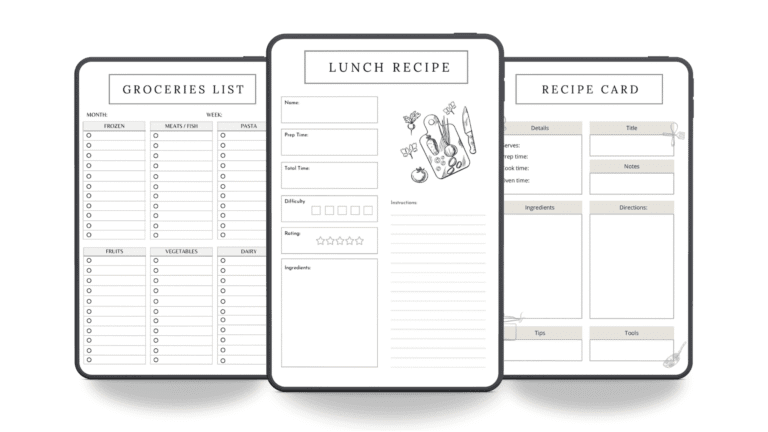
Groceries list page organized by categories (frozen, meats/fish, pasta, fruits, vegetables, dairy).
Food list pages for “food to eat” and “food to avoid.”
Meal ideas and snack ideas lists.
A water tracker page with weekly and monthly layouts.
Why this matters: planning meals reduces decision fatigue and makes it easier to stay consistent.
Sleep and medication/vitamins trackers
Recovery is part of progress.
Included pages:
Sleep tracker with month-by-month layout and daily tracking rows.
Vitamins & medication pages with fields for time, medication, dose, frequency, and date.
Why this matters: when sleep and recovery improve, workouts feel easier and more consistent.
A fun “Fitness Fun” weekly challenge page
This is one of my favorite pages because it’s simple and non-intimidating.
Included:
A weekly checklist style page with daily columns (Mon–Sun) and a list of bodyweight movements like jumping jacks, sit ups, squats, lunges, push ups, toe touches, leg raises, arm circles, knee raises, plus “play outside 30 mins.”
Why this matters: it’s perfect for beginners who need a simple daily baseline.
How to Use This Fitness Planner Effectively
A printable fitness planner works best when you keep it realistic. The goal isn’t to write the “perfect week.” The goal is to create a plan you’ll actually do—and track enough information to improve next week.
Here’s a step-by-step method that feels simple, even for beginners.
Step 1: Choose one main goal (for now)
Open the goals pages and write one main goal you care about. Don’t write five goals. Pick one.
Examples:
“Lose 4 kg in 8 weeks”
“Workout 3 days per week for 30 days”
“Run 5K without stopping”
“Increase strength in squats and push ups”
“Walk 8,000 steps per day”
Then write your “why.” The “why” is what keeps you going when motivation disappears.
Step 2: Plan your week using a “minimum + bonus” approach
Use the weekly workout planner page and set:
Minimum workouts: 2–3 sessions per week
Bonus workouts: 1–2 extra sessions if you feel good
This prevents the “all-or-nothing” trap.
A beginner-friendly weekly plan could look like:
Mon: Full body (30 min)
Wed: Cardio (20–30 min)
Fri: Full body (30 min)
Bonus: Weekend walk + stretching or yoga
Then, when you complete workouts, write them in the “actual workout” column.
Step 3: Track workouts like a coach (not like a judge)
Use the right log depending on your training style:
Cardio training log for time + difficulty.
Strength training log for weights/sets/reps.
Running tracker for pace and “how I felt.”
Yoga log for consistency and intention.
Write short notes like:
“Felt strong”
“Low energy, still showed up”
“Increased weight by 2.5 kg”
“Knees felt weird, reduced reps”
Those notes help you train smarter, not harder.
Step 4: Pick 1–2 habits and track them for 30 days
This is where results happen.
Use the habit tracker and choose simple habits like:
Walk 7,000+ steps
Drink water (aim for consistent hydration)
Protein with every meal
Sleep before midnight
Stretch 5 minutes
Then check the box daily.
Step 5: Review progress every week (10 minutes)
Once a week, do a friendly “weekly review”:
Did I hit my minimum workouts?
What made it easier?
What made it harder?
What can I simplify next week?
If you’re tracking measurements, use the weekly or monthly measurement tracker—no obsession, just data.
Beginner tips that keep you consistent
Start smaller than you think you need.
Never miss twice in a row (if you miss a day, just come back the next).
Track steps on low-motivation days—walking still counts.
Use the “Fitness Fun” page as your fallback routine.
Who This Fitness Planner Is Best For
This fitness planner for beginners and experienced users works because it’s flexible and complete. Here’s who will get the most value:
Beginners
If you’re new, the daily/weekly layouts and the “fitness fun” checklist help you start without overwhelm. You don’t need fancy programming—you need a routine you can repeat.
Weight loss journeys
You’ll love the weight loss tracker, habit tracker, measurement pages, steps tracker, meal planning, and diet log sections. It supports both the workout and lifestyle side of progress.
Home workouts
The weekly planner + daily fitness page + cardio/strength logs are perfect for home workouts. You can track bodyweight exercises, resistance bands, dumbbells, or short cardio sessions.
Gym users
If you train at the gym, the strength training log, weight lifting muscle-group tracker, workout log, and exercise log are designed for consistent training.
Busy schedules
If your week is unpredictable, use the “minimum + bonus” plan and track what you actually did. The planner supports flexible planning without guilt.
Benefits of Using a Printable Fitness Planner
Using a printable planner isn’t old-school—it’s practical. Here are the real benefits you’ll feel:
Accountability: writing your plan makes it feel more “real,” and checking it off feels rewarding.
Motivation: progress becomes visible when it’s recorded, not just remembered.
Habit building: the habit tracker makes consistency feel like a game.
Progress tracking: measurements, steps, and workout logs show improvement you might not notice day to day.
Less decision fatigue: you stop wasting energy deciding what to do each day.
And honestly? It feels good to look back at a month of checked boxes and realize: “I did that.”
Printable vs Digital Fitness Planners
Apps are great, but they aren’t for everyone.
Why printable planners still work better for many people
They’re visible (on your desk, fridge, or in a binder)
They’re distraction-free (no notifications)
Writing by hand can feel more personal and motivating
You can print only the pages you need
When digital is better
If you want automatic reminders
If you track heart rate, GPS runs, or smartwatch data
If you want graphs and automation
Good news: you can combine both. Use your printable fitness planner for planning and habits, and use apps for metrics like pace or heart rate.
Frequently Asked Questions About Fitness Planners
Is this fitness planner really free?
Yes, this is a free printable fitness planner PDF.
Can I print it at home?
Yes—print at home or at a local print shop using standard paper sizes like A4 or US Letter (details in the download section).
Is it suitable for beginners?
Yes. It includes simple planning pages and an easy “fitness fun” checklist that beginners can follow daily.
Can I use it on an iPad?
Yes, you can import the PDF into a note-taking app and write on it with a stylus, but it’s designed primarily as a printable PDF.
Is it editable?
This file is a PDF designed for printing and handwriting. If you want an editable version later, you can create one separately, but this free download is not an editable template.
Does it include meal and water tracking too?
Yes. The daily fitness page includes food sections and water, and the planner includes meal planning and water tracking pages.
Does it track running and strength training?
Yes. It includes running progress and running tracker pages plus strength training logs and weight lifting trackers.
Download Your Free Printable Fitness Planner PDF
You made it to the best part. Here’s where you can get the free printable fitness planner PDF for 2026.

What you’ll receive
You’ll get the complete fitness planner PDF with goals pages, daily/weekly/monthly planners, workout logs, progress tracking, meal planning, habit trackers, and more.
Printing instructions (A4 & US Letter)
File format: PDF (printable).
Paper size: print on A4 or US Letter.
Printer setting: choose “Fit to page” or “Scale to fit” for best alignment.
Tip: If you don’t want to print everything, print only the pages you’ll use this month (weekly planner + workout log + habit tracker is a great starter set).
PERSONAL USE ONLY (Mandatory Disclaimer)
This free Fitness Planner PDF is for PERSONAL USE ONLY.
Redistribution, resale, sharing, or commercial use is strictly prohibited.
If a friend wants it, the best way is to share the link to this blog post so they can download their own copy.
Explore More Free Planning Resources
You may also find these resources helpful:
- Free Trackers & Habit Tracking Printables
- Free Digital Planners & Printable Planner PDFs
- Free Digital Journals & Printable Journal PDFs
- Goal Planners and Productivity Tools
These tools are designed to support organization and clarity in daily
Advertisement
Advertisement